

Before diving into the game itself, it’s worth talking about the people behind it: Viktorija and Alex Glonti.
Alex was a former staff member of the Legal Affairs Committee at the Parliament of Georgia. When the Georgian government made a sudden shift toward a pro-Russian agenda, Alex — a supporter of European integration — found himself on the wrong side of the new order. As the acting government began imposing harsh measures on those who opposed them, he had no choice but to abandon everything and flee. Viktorija followed him into political asylum in the United States.
We arrived in early March of 2025. In August, the two of us started on what was then a nameless project — one that would eventually become Global Ordnance: The Iron Fist.
The setting wasn’t a studio or an office. It was a converted 2003 Ford E250 — a former wheelchair van we stripped down and rebuilt into something resembling a home. A bed with two dog crates underneath, a work table, a 28-inch monitor on a stand, and solar panels on the roof keeping everything running. That’s where this game was made.

The road itself turned out to be something else entirely. American roads are awesome and endless. Over the months we spent crossing the country, we met writers, composers, Hollywood actors, and countless people whose stories we never would have encountered otherwise. Some of this code was written in Walmart and Cracker Barrel parking lots, some on the beaches, some in the forests, some in the mountains. We are genuinely fond of this place and the people in it.
It didn’t start as an ambitious project. Honestly, it started as something to make sitting on the toilet a little less boring. But somewhere along the way, Alex started thinking other people might enjoy it too. That turned out to be a harder problem than expected — and a much more interesting one.
What Is Global Ordnance: The Iron Fist?
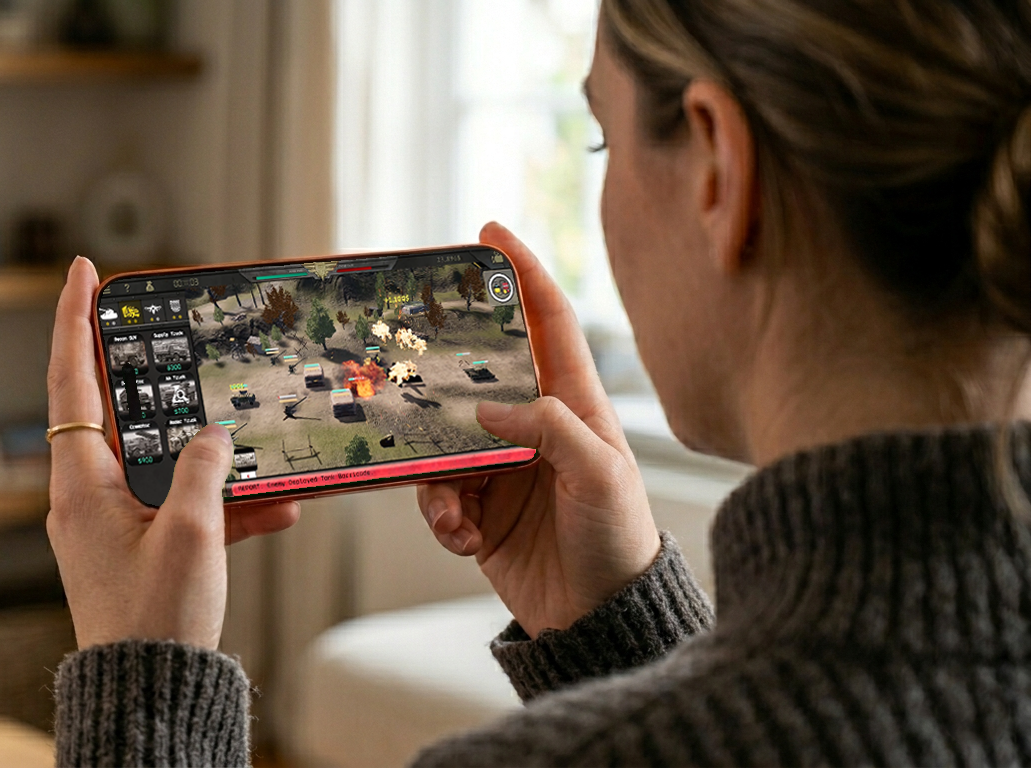
Global Ordnance: The Iron Fist is a real-time strategy game for Android and iOS. You command a mix of armored units, unarmored units, stationary defenses, and aircraft — each with their own role on the battlefield. The objective is straightforward: push your units past the front line and deal damage to the enemy HQ, while holding your own position and making sure enemy units don’t break through to yours. It’s a tug of war, and every decision you make on the field matters.
You don’t start with everything at your disposal. Only a couple of units are available at the beginning of a skirmish — the rest have to be researched mid-battle. What you choose to unlock, and when, is part of the strategy.
The Idea
The goal was simple on paper: build an RTS game that actually works on a smartphone screen. The classic formula — a freely movable camera, full map control — made perfect sense with a mouse and keyboard. On a small display in the middle of a battle, it’s a different story. Something had to give. Either battle dynamics took the hit, or the camera had to be fixed. We fixed the camera.

Optimized for Mobile Platforms
That decision created a new problem. The battlefield had enough room for units, but nowhere near enough for manufacturing buildings. So buildings went away entirely.
Instead, players research and build units through the UI, then deploy them onto the portion of the grid they control. The other side belongs to the AI.
Taking to the Skies
Air combat was something we really wanted in the game, but for a long time, it seemed too difficult to pull off. The battlefield just didn’t feel big enough. Eventually, after a lot of tuning — speeds, maneuvers, attack, and defense logic — a clear path forward emerged.
Aircraft are stationed in hangars outside the player’s view. There are currently five unique planes in Global Ordnance, each with its own role: some intercept enemy aircraft, some specialize in ground targets, and some do both. Players can designate bombing targets directly. If enemy aircraft are in the area when a ground attack or intercept mission is underway, a dogfight breaks out — which can abort the mission entirely. To intercept incoming enemy planes, players need to have a mobile radar deployed on the field.
Keeping It Interesting
Stripping out buildings and base construction meant the game had to earn engagement in other ways. We had a lot of freedom to figure out what that looked like.
The first answer was unit leveling and ammo depletion. Land enough hits and a unit gets promoted, becoming more effective on the field. Ammo depletion added a layer of conservation — a veteran unit is too valuable to throw away, which is where supply trucks came in. They repair damaged units, restock ammunition, and eventually started laying mines too.
Ranks helped, but we wanted more. So we built out an upgrade system. There are currently over 40 unique upgrades in the game, each capable of fundamentally changing what a unit can do and how much it’s worth protecting. Upgrades aren’t cheap, which makes keeping an upgraded unit alive a real strategic priority.
We also added ultimate upgrades — perks that unlock as players research more unit types. The more you explore, the more you gain: faster builds, reduced costs, and other advantages that reward curiosity and experimentation.
And for players who like to go the extra mile, there are over 60 achievements to chase. Unlocking them rewards both cosmetic perks — unique unit skins — and single player buffs that carry real weight on the battlefield. There’s always something to work toward.
And Then We Added Game Modes…
Global Ordnance: The Iron Fist has three timed challenge modes: 1-minute, 3-minute, 5-minute, and sub-10-minute. When the clock runs out, whoever dealt more damage to the enemy HQ wins.
That one rule changes everything. Turtling stops working. You gotta be FAST! Waiting for the perfect setup simply stops working. Aggression becomes the only viable strategy — and the sooner you commit to it, the higher your winning chances. Same units, same battlefield, completely different way to enjoy the game.
There’s also what we call a “Paid Unit Maintenance” or simply the “Upkeep Mode”, where every military asset you keep on the field costs in-game money. No more hoarding. No more flooding the map and hoping numbers win. You afford to field fewer units, you protect them like they are really important (cause they are), and every deployment decision matters more than ever now.
The AI Opponent
None of this would matter without a decent opponent to play against. A strong AI was a core requirement from day one.
What we landed on is what we call Adaptive AI. It doesn’t just follow scripted behavior — it watches how you play and adjusts accordingly. The longer you spend with the game, the more tactics it has absorbed and learned to counter. The goal is for every match to feel competitive, regardless of the player’s skill level. The current version gets there, though it still has room to grow.
The Units That Stick With You
Even with solid systems in place, we felt the game needed some memorable, larger-than-life units — the kind that classics of the genre are known for. So we added a few: an experimental double-barrel tank called the Mammoth, a War Airship, a V2 ballistic missile, and an Atomic Bomber. They’re powerful — arguably close to overpowered — but using them well still takes real strategic thinking.
The whole game is backed by over a dozen original metal tracks. It’s not background filler noise — it fits the tone of what’s happening on the field.
The Testing Phase and Generative AI Disclaimer
With limited resources, we had to rely on the feedback of people who enjoy gaming, not professional testers. So, technically, testers in those early stages were mostly random game enthusiasts we met at all sorts of places across the country. Watching someone pick up the game cold and find their footing — thanks to the tutorial and the adaptive AI — was one of the better feelings along the way.
Regarding generative AI: we use it mainly for inspiration, and for certain mundane, repetitive development tasks where it makes sense. But our aim is to involve more visual and audio artists in the project as it grows. We deeply respect the creative process and everyone who has dedicated themselves to the craft of art — and we want more of that in this game — genuine human output, with all the strengths and quirks that come with it. Eventually, Global Ordnance: The Iron Fist will shed its AI-generated assets and become a fully artist-made project. That’s the goal we’re working toward.
What’s Next
Global Ordnance is not a release-and-done kind of project. We plan to keep updating and expanding the game long after it launches.
One of the nearest goals is improving the Adaptive AI. Right now, it takes several matches before it gets a proper read on how good a player is. The aim is to bring that assessment down to a single match. The key is figuring out which in-game actions are reliable indicators of experience — things like how frequently a player upgrades their units, or how quickly they deploy a unit after it becomes available. An experienced RTS player behaves differently from a newcomer in subtle but consistent ways, and teaching the AI to recognize those patterns faster is the next step.
We also want to add a single-player campaign — something that makes the game stick in your memory long after you’ve put it down. Global Ordnance already has the foundation for it. The colonel who guides you through the tutorial is a character named Hawk, originally conceived as the protagonist of a separate PC RPG called Hawk: The Initiation. That game is still in the future, but in the meantime, Hawk found his way into Global Ordnance. A campaign built around him would give the game a real story to tell — and players a reason to care beyond the battlefield.
The big dream is multiplayer. Two commanders, one battlefield — that’s the vision! Getting there will take time, but it’s where we want to end up.
A closer dream is adding units from different historical epochs. The idea is that through research, players would gradually progress through the ages, unlocking access to increasingly powerful units as they advance. It would add a whole new dimension to how the game is played and give long-term players something to work toward.
There’s a lot more road ahead — and we’re just getting started. Expect weekly updates, so you won’t be waiting long for new units, maps, and quality-of-life upgrades. We’re building this with the community, not just for it — so bring your ideas, bug reports, balance feedback, and unit wishlists. We’re always listening to the feedback.
Free to Play, Fair to Everyone
Pay-to-win was never on the table. As someone who grew up on RTS games, I knew the mobile space was missing something: a real strategy game with the soul of the classics, no strings attached. Global Ordnance runs a small number of ads to keep the lights on, but the game itself is fully accessible — no paywalls, no shortcuts you have to buy. Just the game.
That’s what we set out to build. We think we’re getting there.
We’re two people building this with limited resources, which means the game may not be perfect out of the gate. Bugs happen, and when they do, player feedback is how we find and fix them. If you run into something, let us know — that kind of cooperation genuinely makes the game better for everyone, and we take every report seriously.
If you enjoy what we’re doing and want to help us keep going, you can support the project on Patreon. Every bit helps two people building something they genuinely care about, one campground at a time.
Global Ordnance: The Iron Fist Privacy Policy
Global Ordnance: The Iron Fist is out now on Android, free, with no purchases of any kind. Get it on Google Play · See every unit and mechanic · Read the latest devlog
Get the next update before you open the game
Global Ordnance ships an update most weeks — new units, new mechanics, and the exact numbers that changed. Every devlog goes straight to your inbox the day it lands. No other mail, unsubscribe in one click.